Sludge dewatering is where a produced water treatment program either proves its economics or quietly gives the savings back. Clarifiers may produce cleaner overflow, but every pound of solids captured upstream has to go somewhere. If the sludge conditioning chemistry is weak, operators pay for it in wet cake, overloaded roll-off boxes, centrifuge instability, and more truck traffic than the site budget expected.
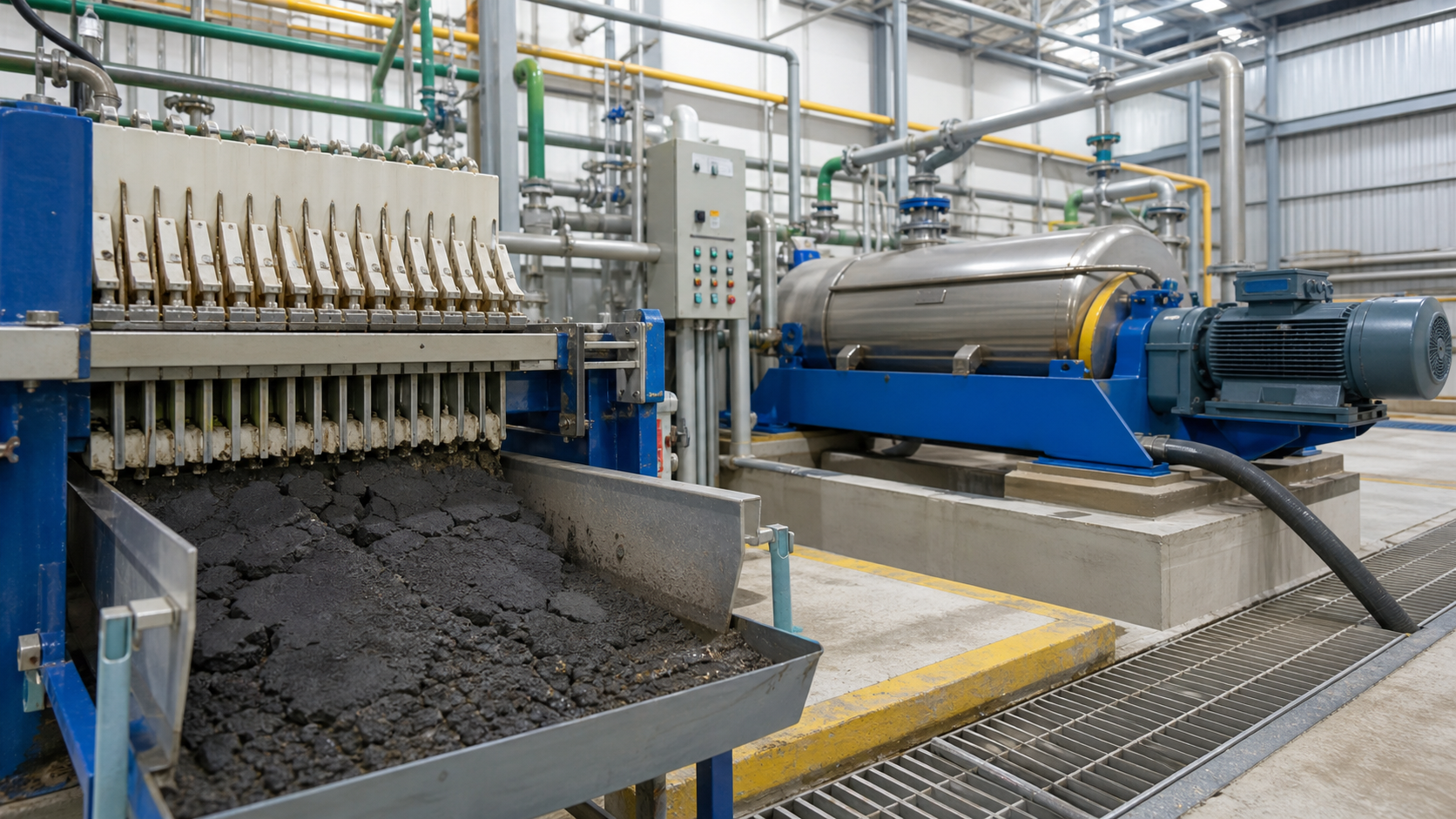
For most Permian Basin oilfield sludge streams, cationic polyacrylamide (CPAM) is the starting point for serious dewatering work. The reason is straightforward: much of the sludge matrix is built from negatively charged fine solids, clay, iron precipitates, residual organics, and oil-coated particles. CPAM provides charge neutralization first, then polymer bridging second. That combination is what turns a soft, water-holding sludge into a stronger floc that can release water under mechanical pressure.
Why CPAM Behaves Differently in Sludge Than in Clarification
In primary clarification, operators often judge polymer performance by floc formation speed, settling rate, and overflow turbidity. In sludge dewatering, those metrics still matter, but they are not enough.
A filter press or centrifuge cares about different outcomes:
- Cake release from cloth or bowl surfaces
- Filtrate or centrate clarity
- Cake dry solids
- Polymer consumption per dry ton
- Equipment throughput stability
- Whether the floc survives shear before separation
That last point matters. A CPAM that forms beautiful floc in a jar may break apart in a high-shear feed pump or long injection line. For dewatering, the make-down system, injection point, and mixing energy are part of the polymer selection process.
Charge Density Selection
Permian Basin sludge is not one material. Early flowback sludge, mature produced water sludge, skim tank bottoms, and DAF float all behave differently. Still, a practical starting range is:
| Sludge Condition | Typical CPAM Direction | Field Concern |
|---|---|---|
| High oil and organics | Medium to high cationic charge | Avoid overdosing and sticky cake |
| High clay fines | Higher molecular weight CPAM | Protect floc from shear |
| High TDS brine sludge | Jar test several charge levels | Salt can change charge behavior |
| Biological or mixed solids | Medium-high cationic charge | Watch centrate clarity |
If the cake is wet and slimy, the first suspicion is usually under-conditioning or the wrong charge profile. If the filtrate turns cloudy after increasing dose, the program may have crossed into overdosing or floc shear.
Filter Press Notes
Filter presses reward strong, drainable floc. The goal is not only to make large particles; it is to build a cake structure with enough permeability for water to move out under pressure.
Practical checks:
- Dose CPAM into a low-to-moderate shear zone before the press feed point.
- Give the polymer enough contact time to condition solids, but avoid long transfer lines after floc formation.
- Track cycle time together with cake solids. Faster cycles are not useful if disposal weight increases.
- Watch cloth blinding. A sudden rise in wash frequency often means the polymer program is not building the right floc structure.
When a press is performing well, the improvement shows up as drier cake, cleaner filtrate, steadier cycle times, and fewer operator interventions.
Centrifuge Notes
Centrifuges are less forgiving because shear is built into the separation process. The polymer has to form floc that is strong enough to survive acceleration but open enough to release water.
Field symptoms are useful:
- Wet cake with clean centrate: polymer may be underdosed or low charge.
- Dirty centrate with wet cake: floc may be breaking under shear.
- Sticky cake on discharge: overdosing or wrong polymer architecture may be present.
- Good test jar, bad centrifuge result: injection point and shear history need review.
The best results usually come from testing CPAM options against actual sludge, not only produced water feed. Sludge composition is the more relevant sample for dewatering decisions.
Supplier Data Is Only the Starting Point
Product sheets help narrow the candidate range, but they do not replace bench testing. For teams comparing cationic grades, review the supplier information for cationic polyacrylamide alongside your own jar test results, cake solids data, and filtrate quality targets.
The winning CPAM program is the one that performs in your equipment, with your sludge, under your operating constraints.
For the purchasing stage, see Produced Water Sludge Centrifuge: PAM Tender Acceptance Tests for the corresponding supplier evidence and acceptance decision.