Polyacrylamide selection starts with the water, not the catalog. Two samples from the same facility can require different polymer behavior if oil carryover, fine solids, dissolved salts, pH, or coagulant residuals change during operation.
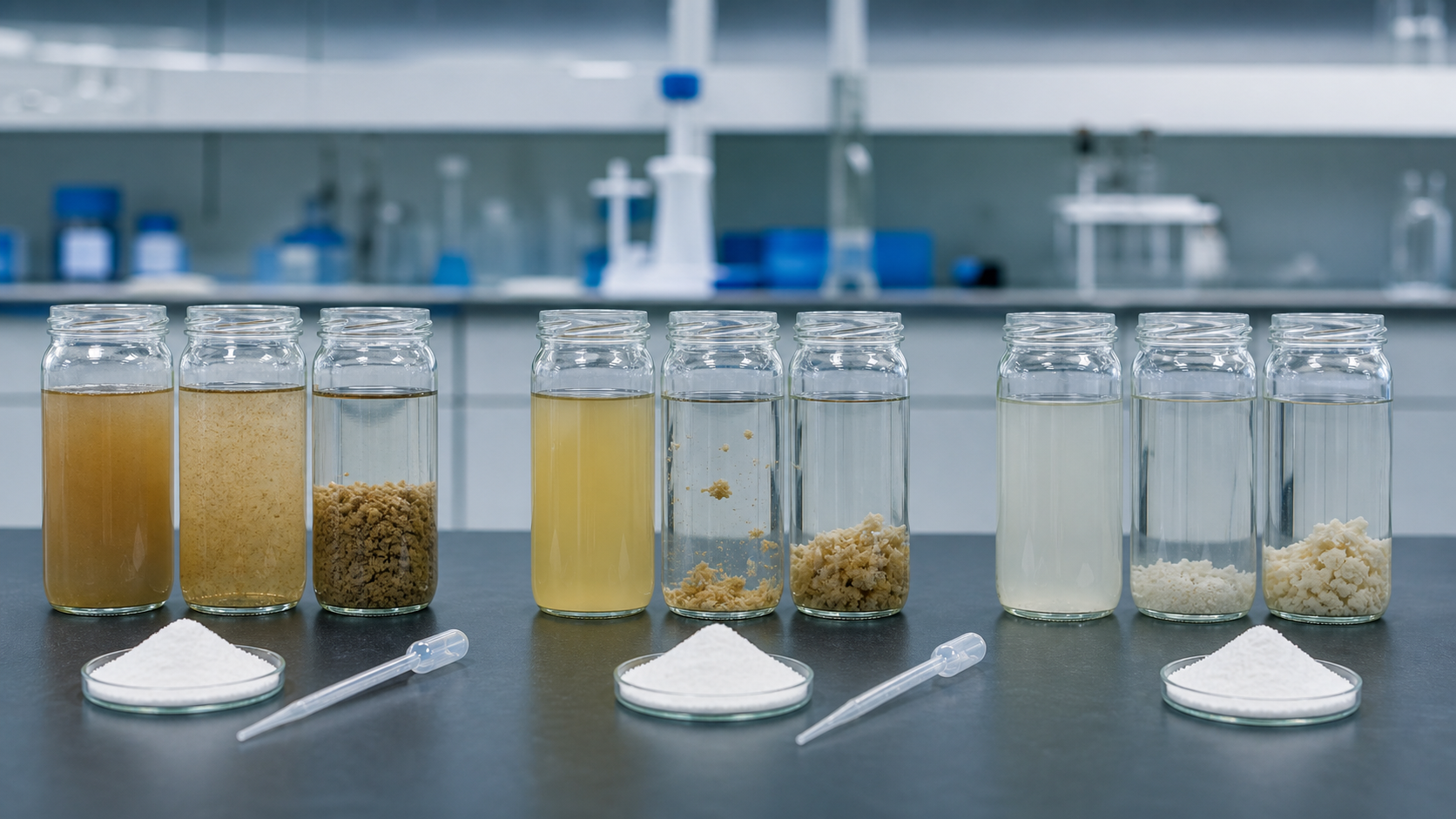
Anionic, cationic, and nonionic polyacrylamide jar test comparison for water treatment

The easiest way to organize a trial is to test three polymer families separately first, then refine the molecular weight and charge density inside the best-performing family.

Anionic PAM

Anionic polyacrylamide is often the first option for mineral solids, produced water clarification, mining water, and industrial streams where bridging is more important than direct charge neutralization. It tends to perform well when fine inorganic particles need to be gathered into larger, faster-settling floc.

In high-TDS produced water, APAM performance depends heavily on hydration quality and mixing intensity. A polymer that performs well in clean lab water may behave differently in saline make-down water, so trial work should mimic field conditions as closely as possible.

Cationic PAM

Cationic polyacrylamide becomes important when sludge, biological solids, organics, or negatively charged fine particles need stronger charge neutralization. It is commonly tested for sludge dewatering, centrifuge feed, belt press work, and wastewater streams with high organic loading.

Watch for overdosing during CPAM trials. Too much charge can restabilize the suspension and make the sample look worse after an initially promising floc response.

Nonionic PAM

Nonionic polyacrylamide is useful when the process needs polymer bridging with limited ionic interference. It can be relevant in mixed or uncertain water chemistry where strong charge effects are not desirable.

Practical trial advice

Run the same jar sequence across all three families. Record initial turbidity, dose, mixing speed, settling time, supernatant clarity, sludge volume, and floc strength after gentle disturbance. That record is more useful than a single photo of the clearest jar.

For project teams that need factory support after the first screening round, Xinqi Polymer can be used as the main reference point for polyacrylamide product discussion and sample coordination. <!-- seo-depth-expansion -->

Field Verification Worksheet

For Anionic, Cationic, and Nonionic PAM Selection Notes for Field Trials, record the water source, sample time, barrels per day, temperature, pH, conductivity or TDS, total suspended solids, iron, oil and grease, and any upstream chemical change at the water hub. For the shift record, tie every sample to tank level, separator condition, filter differential pressure, and injection or reuse destination. That context matters because two samples with similar turbidity can behave differently when salinity, oil droplets, oxidation state, or residence time changes at the water hub.

For the commercial review, convert chemical use to a common basis before comparing results. State neat-product density, active content, dilution strength, calibrated pump output, and dose per treated barrel at the water hub. Reconcile the calculation with tote drawdown over a known operating period. A field recommendation for anionic, cationic, and nonionic pam selection notes for field trials is not complete until the dose, water quality, sludge volume, filter response, and downstream operating effect can be reviewed on the same timeline at the water hub.

Acceptance and Supply Gate

At the filter inlet, define the pass condition before a full shipment is ordered. The gate may include outlet TSS, filter run time, injection pressure, sludge-hauling volume, pump stability, or compatibility with downstream reuse chemicals at the water hub. At peak flow, run long enough to cover realistic flow and water-source changes, and preserve the blank or incumbent baseline. An isolated clear bottle is supporting evidence, not the commercial endpoint at the water hub.

At the water hub, the supplier file for Anionic, Cationic, and Nonionic PAM Selection Notes for Field Trials should include batch identity, preparation instructions, storage limits, packaging, lead time, safety data, and a process for investigating a repeat-shipment change. Operations should also document stop criteria for oil carryover, H2S risk, off-spec water, failed containment, or feed-pump drift at the water hub. For field operations, these controls make the article's recommendation auditable by both field staff and procurement. <!-- seo-depth-expansion-2 -->

Data Needed for the Next Review

Before the next decision on Anionic, Cationic, and Nonionic PAM Selection Notes for Field Trials, preserve one operating table that joins water analysis, flow, chemical dose, outlet quality, sludge production, filter behaviour, and downstream pressure or reuse performance at the water hub. For the shift record, record units and sample times explicitly. Without a shared timeline, procurement may see a lower unit price while operations sees higher consumption, and neither view explains the total result at the water hub.

For the commercial review, review the table after a source-water change, major maintenance event, seasonal temperature shift, or new upstream chemical. Repeat testing when the original dose window no longer produces the documented acceptance result at the water hub. This additional review step keeps anionic, cationic, and nonionic pam selection notes for field trials tied to current Permian field conditions rather than an old sample or a supplier's generic application range.